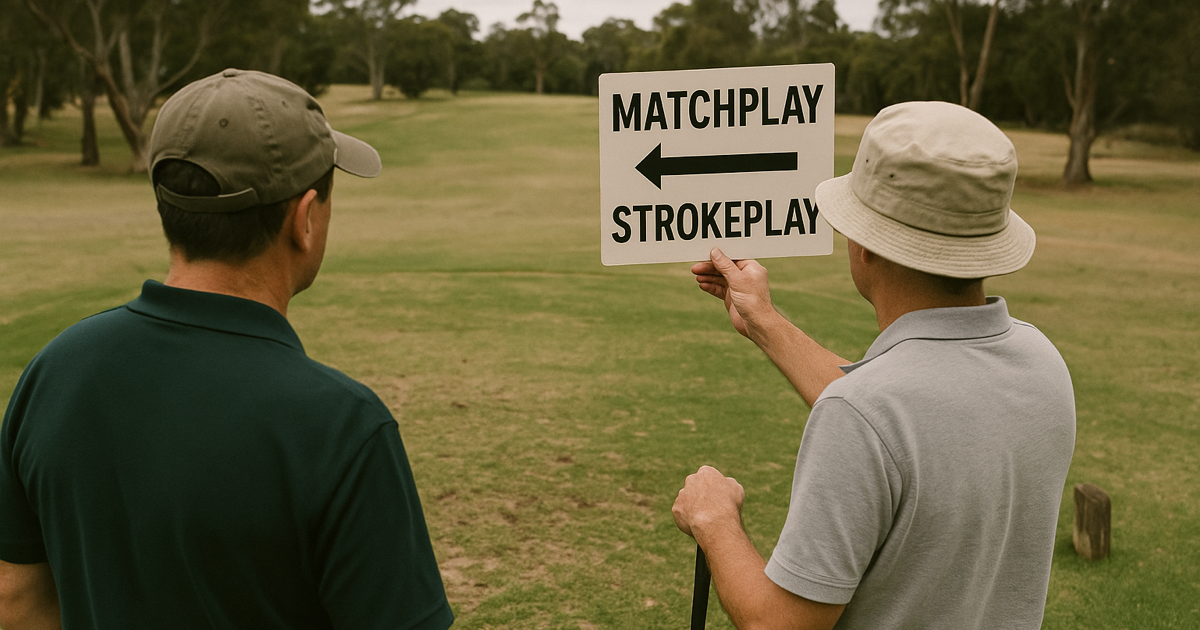
If you're running a comp and stuck between matchplay and strokeplay, here's the short answer: matchplay is better for a head-to-head 1v1 or 2v2 with similar handicaps, strokeplay (and its handicap-adjusted cousin Stableford) is better for a field of three or more players with mixed abilities.
That's the decision in one line. The rest of this post explains why, and the situations where you might break the rule.
Strokeplay in one paragraph
You play every hole. You count every shot. Total strokes for 18 holes is your score. Lowest total wins. Handicaps adjust your gross to a net total for the comp.
Strokeplay is what you see on the TV at a Masters or US Open. Every shot counts. It's an honest measure of total performance — but one disaster hole can wreck your scorecard, even if you played the other 17 well. That's why Stableford (which converts strokeplay scores into points per hole and caps the damage at 0 per hole) became the AU social default.
Matchplay in one paragraph
You play head-to-head against one opponent (1v1) or as a pair against another pair (2v2). Each hole is its own mini-competition — whoever scores lower on that hole wins the hole. You don't care by how many. After 18 holes (or sooner if the match is decided early), whoever has won more holes wins the match.
Matchplay is what you see at the Ryder Cup. Different game, different rhythm, different feel.
The five differences that actually matter
1. Disaster holes don't hurt in matchplay
In strokeplay, an 8 on a par 3 costs you 5 strokes against par. In matchplay, an 8 against your opponent's 4 costs you exactly one hole. The next hole is a clean slate. Strokeplay punishes the catastrophe; matchplay forgets it.
This is the biggest behaviour change in matchplay — you can take risks on a hole knowing the worst case is "lose the hole" not "lose the comp".
2. Strokeplay scales to any field size; matchplay doesn't
A strokeplay or Stableford comp can have 4 players or 40 — everyone plays the same course, you compare totals, the highest wins. Trivial to organise.
Matchplay only works as pairs. If you have an odd number, someone draws a bye. If you have a field, you need a bracket — a knockout structure that requires multiple rounds across multiple weeks or one big day. The classic AU "club championship matchplay" is a bracket over several Saturdays. Beautiful comp, but a logistics job.
For 8 players you can run a single-day matchplay over 9 holes (8 → 4 → 2 → 1) but it needs a structured day. For 16 players the same thing over 18 holes works as a one-day "club championship knockout". For 32+ it's a multi-week season.
3. Matchplay is more social, strokeplay is more competitive
You spend matchplay focused on one person. You're shaking their hand on every tee, watching their tee shot, conceding short putts ("that's good"), having a chat between shots. Strokeplay you spend trying to ignore everyone else and play your own game against the course.
For a corporate day, a charity day, or a society round where the social fabric matters more than the result, matchplay between paired players feels right. For a regular comp where mates are competing for a season order of merit, strokeplay (or Stableford) is the right call.
4. Handicaps work differently
In matchplay 1v1, the lower handicapper gives the higher handicapper the difference in their playing handicaps as strokes, distributed by stroke index. A 6-handicapper playing a 14 gives away 8 strokes — one on the 8 hardest holes.
In strokeplay, every player plays off their own playing handicap, full stop. No "difference" to calculate.
This makes matchplay handicapping slightly trickier but eminently fair — even a 24-handicapper has a real chance against a 6 because they get a stroke on most holes.
5. The match can end before 18 holes
A matchplay match ends as soon as one player has a lead bigger than the holes remaining. If you're 4 holes up with 3 to play, the match is "4 and 3" — you've won, no need to play the last 3 holes. This is the source of those "Smith won 5 and 4" results you see at Ryder Cup.
Strokeplay always plays to 18. You never know who's won until the last putt drops.
When to pick which
| Situation | Pick |
|---|---|
| Regular monthly social comp, 8–40 players, mixed handicaps | Stableford (strokeplay cousin) — fair, fast, forgiving |
| Corporate or charity day, 16–32 players, social atmosphere | Stableford for the field comp + 1v1 matchplay side bets between teams |
| Club championship knockout, single-elimination bracket | Matchplay — that's literally the format |
| Pairs / Foursomes / Greensomes event | Matchplay — pairs against pairs |
| Two mates settling who's better | Matchplay — only format that makes sense head-to-head |
| Season-long order of merit across multiple comps | Stableford — totals add up cleanly week to week |
| Ryder Cup-style team event | Matchplay — that's the format, and you can split it across Singles, Foursomes, Better Ball |
What about Skins and Wolf?
Both are layered on top of whatever format you're playing. Skins assigns a dollar (or point) value to each hole and tracks who wins it as a side game alongside the main comp. Wolf rotates a "Wolf" position around the group hole-by-hole. These aren't alternatives to matchplay or strokeplay — they're add-ons. Most groups run Stableford as the comp and a Skins or Wolf side-game for the wagering.
The decision shortcut
If you're still stuck: default to Stableford for the comp, and run a matchplay side competition between pairs or teams if you want the head-to-head drama. Best of both — your field gets a fair comp, your competitive friends get their 1v1.
That's how most well-run AU society days work. Stableford determines the trophy. Matchplay determines who buys the beers.
A note on running matchplay practically
If you do run a matchplay event, the admin overhead is real:
- Brackets need to be drawn. Usually random, sometimes seeded by handicap.
- Matches need a finish window. Either everyone plays at the same time, or you give players a week to schedule their match.
- Scores need to be reported. "Smith beat Jones 3 and 2" — you need a system for collecting these.
- Byes happen. Odd numbers in a bracket mean someone advances without playing. Random draw for byes, or seed the bye to the highest handicapper as a courtesy.
For the comp itself, modern apps (including The Nineteenth's Singles Matchplay) handle the hole-by-hole scoring and the "match dormie / match over" maths automatically — so you don't have to track the cumulative state in your head while you're trying to play.
Bottom line
For 90% of social golf comps in Australia: Stableford is the right call.
For the other 10% — club championship knockouts, society singles cups, head-to-head settling — matchplay is right. And in those cases, the format is half the fun.
If you want to run a comp without doing the maths in your head, The Nineteenth handles both formats and a few others — free for your first three comps.